Category: Internet
Scheduling Mastodon posts without third-party tools
About the New Terms of Use of mastodon.social
On moderation in the fediverse and in general
Trusting invalid SSL certificates is wrong
So let me put it clear from the first line: trusting invalid certificates is wrong.
And now I will explain why it’s wrong and why there are few excuses for it.
We are talking here about certificates for SSL encryption, which serves basically two purposes:
- Privacy — data is transferred encrypted and can only be decrypted by the intended recipient and not a third party wiretapping the line.
- Authentication — making sure the receiving end that will be able to decrypt the data is who they claim to be and data is not diverted to a different receiver by a third party with access to manipulating our transfers.
Invalid certificates obviously defeat the second purpose of verifying the other end’s identity:
Casim.ir URL shortener returns
Let's start with a bit of history.

Casim.ir is a URL shortener developed by Nicolas Hoizey in PHP eleven years ago (stylized by then as Cas.im/ir) with the intention of creating a light and simple URL shortener.
About seven years ago, I installed it to create my own private URL shortener at chu.so and some other open and public ones with some modifications on Nicolas's project.
Shortly after, I started contributing to the project with improvements and bugfixes and almost instantly Nicolas gave me direct write permission.
No, don't blame the user
It is unusual to see a computer engineer defending users. Even more if the engineer is a system administrator. It is known that the relationship between system administrators and users is tense. But when somebody tries to fool me, I get even more tense.
Let's go over the facts.
The registrar
I'm updating the administrative contact of some domain names registered with a well-known Spanish registrar. The company listed as the administrative contact no longer exists and now the domain names belong to another company, so I have to update all the data, but that's another story. Now I will transfer the domain to another registrar, so I only need to change the e-mail address to get the auth code to transfer the domain name to another registrar. I will correct the rest of the contact details at the new registrar.
I leave all data as is and just change the e-mail address, then I submit the form and it does nothing. It does not send the data, shows no message, no action, nothing. I try with different browsers and the result is always the same. Since I know a little bit about this, I go to the browser error console and this is what I found there:
RapidShare premium download with Opera
I must blame Fonso again, because he asks me about something like FlashGot but for Opera in Linux, i.e., a way to be able to select a block of RapidShare URLs to download them with a premium account with a download manager. So when I didn't find anything, I started with it.
I finally got a bash script that receives a list of links as parameters and adds them to Aria with a RapidShare premium account. Using aria was not a choice, since it was the only one, apart from wget, that supports RapidShare premium accounts (i.e., HTTP authentication) without problems.
How to get a .1.vg domain name

Some times visitors arrive here googling for how to get a .1.vg domain name (yes, I told you, I spy you), so I'm finally going to say you how to get it, then you can stop searching.
You can get one at FreeDNS, where you can host your domain with a free DNS service with access to A, NS, MX, CNAME, TXT, ... records or web forward.
With a free account you are allowed to register five domains (if I'm right), either a top-level domain (like a .com) or a subdomain from the more than 30,000 they have registered as .1.vg. And giving donations you get access to TTL and wildcards and the records number quota is increased.
Opera web browser with usage report tool for Gentoo
Opera has just announced through its desktop team the releasing of a new developing version for betatesting that includes a tool that makes reports about browser usage and configuration and without private information to send it anonymously to the company to improve the browser. Someone named this Opera 'Spyware', though it's a feature not present in official releases, which can be deactivated, you can read reports before sending it and the browser warns you about this the first time it's run.
Google and Yahoo/MSN: Innovation and Imitation
 |
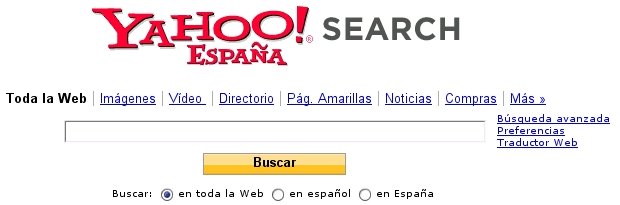 |
| Google searches | Yahoo! searches |
 |
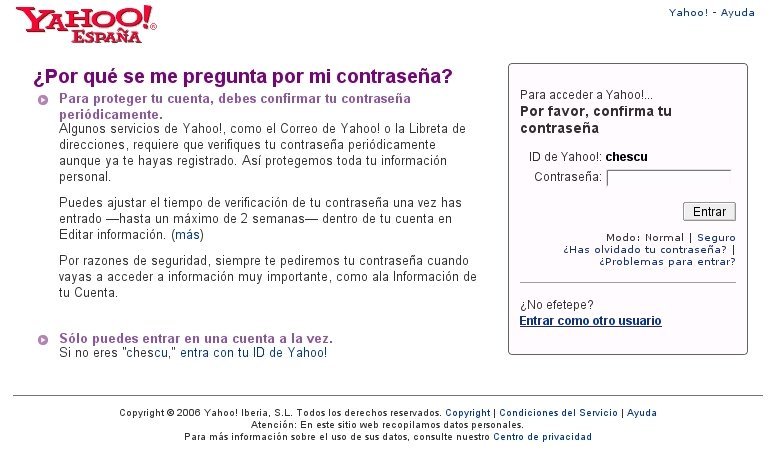 |
| Google login | Yahoo! login |
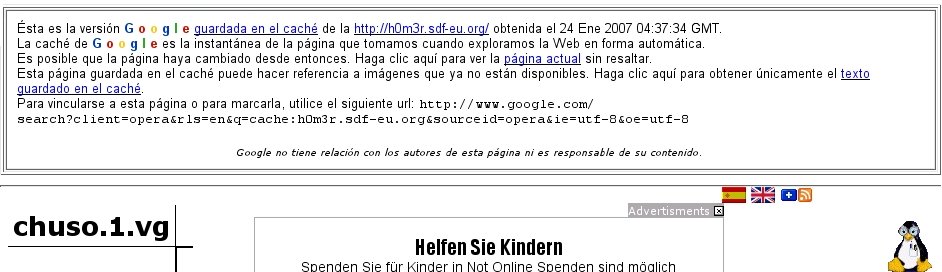 |
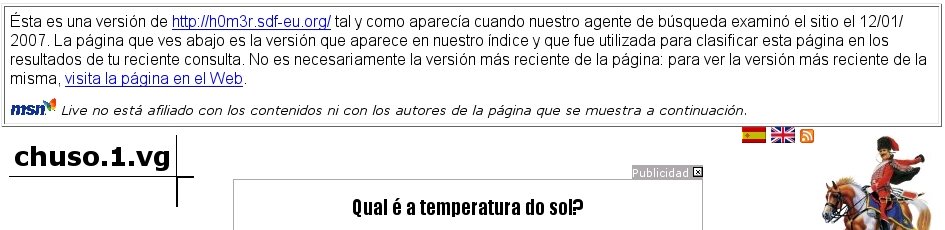 |
| Google cache | MSN cache |
 |
 |
| Google search results with ads | Yahoo! search results with ads |
 |
 |
| Google ads | Yahoo! ads |