chuso.net

Category: Science

No, it doesn't work for you

We've all heard this ever. Some may even have used this argument: "it works for me." It seems that it works as a defense of the effectiveness of everything. From homeopathy to ouija including NLP or MMS. If you've tried it and you've seen that it works and maybe you even know more people that say that it works, we could say that its effectiveness is proved, right? Let's see why this argument could be wrong.

Our perception of efficacy is affected by certain psychological and sociological biases that prevent us from correctly assessing the results and even alter them unconsciously. This is a well-known phenomenon and this is why personal experience is a questionable way of generating knowledge. Instead, we use studies carried out using the scientific method that has been designed to attempt to correct and neutralize these biases in order to try to get results as objective and solid as possible. Also, if the results resist falsification tests and replication by different teams, we ensure a more consistent result.

For greater clarity when explaining why personal experience is not a valid proof, we are going to review with a little more detail some of these biases with examples of how they affect the assessment of an outcome. It should be clear that all we apply these biases, mostly unconsciously. So we can't assume bad faith on those who fall into these biases and can't either consider ourselves free of them.

  • Fuente: Amazon
    Source: Amazon

    Confirmation bias. Probably one of the best known and studied. It may be referred to by many other names or subtypes, some of which are also explained below, like recall bias, cherry-picking, biased interpretation, etc. It is the tendency we have to give more value to cases that confirm our point of view. This applies, for example, if we take a homeopathic preparation every time we have a cold and the third part of the times we do it, we are healed. If we tend to believe that homeopathy works, we will give more validity and representativeness to that cases where we've cured even though it is less the times —and however, it may not be representative even if they were most of the cases, as we will see below. It is the unconscious tendency we have to give more relevance to cases that favor our point of view and disregard those who contradict it.

"Science is just an opinion," said the postmodern

"Science is just an opinion, as valid as any other," said the postmodern guy in a tweet sent from his smartphone with 4G connection while the MEPG stream received through a fiber optic cable was being decoded to stimulate the electrodes that will polarize the glass that will shape the image of Deepak Chopra on his TV. The same MPEG stream was also being decoded to a series of electrical impulses that cause disturbances in the air that reached his ears to become the sound of the words of the Indian spiritualist.


Coriolis Effect and drains, again

It's a widely held belief that water falls down the drain turning in the same direction in one hemisphere of the Earth and the opposite direction in the other hemisphere.
I remember, an X-Files episode (which implies that this happened about 15 years ago) where Mulder saw the water falling down the drain turning clockwise and that, Scully, is impossible because we are in the northern hemisphere and water always turns counterclockwise here.
It's also quite famous that episode of The Simpsons in which Bart rides a mess with Australia on account of the water spinning in different directions depending on the hemisphere you are on. It is a premise that is repeated several times on the episode giving it as true, to the regret of those who are hardcore fans of this show and feel sorry about its continued lurching between episodes that defend critical thinking, positivism and rationalism in contrast to other episodes that do just the opposite defending pseudoscience, postmodernism and magical thinking. Fortunately, it seems that the times of magic in The Simpsons are left in the past (excepting those pleasant Halloween specials) and ultimately the rational option is gaining ground. Or maybe it's just what I want to think.
Actually, Bart's attitude during the chapter is quite strict from a scientific point of view, the problem is with the facts observed during Bart's experiments. Lisa transfers to Bart her beliefs about drains. But Bart, instead of accepting it without doubts, adopts a skeptical attitude and is willing to test it and try to nullify it. Since he doesn't find a counterexample in a first trial, he provisionally accepts the hypothesis but goes on doing more experiments in search of a counterexample. And so it ends up causing the conflict with Australia.
During the chapter, Bart confirms in each trial that water turns in the direction predicted by the hypothesis, but would it be the same in the Real World ™ instead of a cartoon world? How many of those who have heard this belief have acted the same way? How many have tested the transmitted hypothesis? Anyway, recently, the same day, two separate and distinct people said quite convinced to me the plausibility of this hypothesis, but I could not just accept it. I could not deny it either without a counterexample. I had to test the hypothesis, do the experiment and then say what I have to say about it with some basis. And this is the result:


My complaint to TED about TEDxValenciaWomen

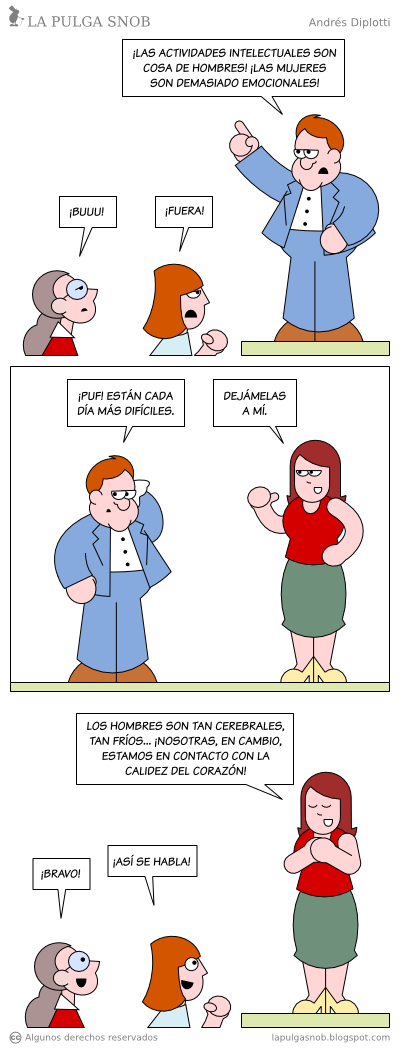
La pulga snob - Sexista

This Saturday, December 1st, a TEDx event was held in Valencia: TEDxValenciaWomen. Two other TEDx events were held this weekend in Spain: TEDxGalicia and TEDxPonferrada on Friday, but I couldn't pay attention to those two because it was a weekday, I'll wait for the videos to be published.

TED events are a set of conferences where speakers can talk about different topics. Originally these were mostly technological topics, as the name suggests. Later they were opened to some other topics having as objective dissemination and science. Then more topics where allowed and nowadays they cover a lot of issues and their current slogan is "Ideas worth spreading". Although opinions have emerged lately that say TED principles have gradually been corrupted to accommodate other ideas that do not deserve so worth spreading.


And what does science say about that?

You probably have heard some popular belief with a supposed scientific base of the type of humans use only 10% of their brains, you can kill somebody dropping a coin from a tall building, hair and nails continue growing after death or water drains backwards in the other hemisphere.

Surely that you have heard more than twenty, but twenty are solely those that a recently published document (a little lacking in references) tries to solve.


Hex counting

In the latest comic strip of Raulito el friki the hexadecimal numeration is mentioned and some readers are sorry not to dominate it. Here comes the explanation.

The decimal numeration begins with 0 and when the 9 -the last symbol- is reached, the next is 0 and we carry 1 to add it to the following more significant digit; i.e., if we add 1 plus 9, the result is 0 and we carry 1 for the following digit.