Category: Debate
About the New Terms of Use of mastodon.social
On moderation in the fediverse and in general
Why we care about Paris and not about Kabul
Every time a terrorist attack in the West caught the attention of the media, a response arises from some ideological sectors. Whether the Boston Marathon, Charlie Hebdo or the slaughter yesterday at the Bataclan, there are always those who, after the first signs of media attention, make the same comment:
By the way, terrorist attacks like the Paris one happen almost daily in Africa or Asia, but they don't shock us. Because it's Africa. Or Asia.
No, it doesn't work for you
We've all heard this ever. Some may even have used this argument: "it works for me." It seems that it works as a defense of the effectiveness of everything. From homeopathy to ouija including NLP or MMS. If you've tried it and you've seen that it works and maybe you even know more people that say that it works, we could say that its effectiveness is proved, right? Let's see why this argument could be wrong.
Our perception of efficacy is affected by certain psychological and sociological biases that prevent us from correctly assessing the results and even alter them unconsciously. This is a well-known phenomenon and this is why personal experience is a questionable way of generating knowledge. Instead, we use studies carried out using the scientific method that has been designed to attempt to correct and neutralize these biases in order to try to get results as objective and solid as possible. Also, if the results resist falsification tests and replication by different teams, we ensure a more consistent result.
For greater clarity when explaining why personal experience is not a valid proof, we are going to review with a little more detail some of these biases with examples of how they affect the assessment of an outcome. It should be clear that all we apply these biases, mostly unconsciously. So we can't assume bad faith on those who fall into these biases and can't either consider ourselves free of them.
-

Source: Amazon Confirmation bias. Probably one of the best known and studied. It may be referred to by many other names or subtypes, some of which are also explained below, like recall bias, cherry-picking, biased interpretation, etc. It is the tendency we have to give more value to cases that confirm our point of view. This applies, for example, if we take a homeopathic preparation every time we have a cold and the third part of the times we do it, we are healed. If we tend to believe that homeopathy works, we will give more validity and representativeness to that cases where we've cured even though it is less the times —and however, it may not be representative even if they were most of the cases, as we will see below. It is the unconscious tendency we have to give more relevance to cases that favor our point of view and disregard those who contradict it.
"Science is just an opinion," said the postmodern
"Science is just an opinion, as valid as any other," said the postmodern guy in a tweet sent from his smartphone with 4G connection while the MEPG stream received through a fiber optic cable was being decoded to stimulate the electrodes that will polarize the glass that will shape the image of Deepak Chopra on his TV. The same MPEG stream was also being decoded to a series of electrical impulses that cause disturbances in the air that reached his ears to become the sound of the words of the Indian spiritualist.
No, don't blame the user
It is unusual to see a computer engineer defending users. Even more if the engineer is a system administrator. It is known that the relationship between system administrators and users is tense. But when somebody tries to fool me, I get even more tense.
Let's go over the facts.
The registrar
I'm updating the administrative contact of some domain names registered with a well-known Spanish registrar. The company listed as the administrative contact no longer exists and now the domain names belong to another company, so I have to update all the data, but that's another story. Now I will transfer the domain to another registrar, so I only need to change the e-mail address to get the auth code to transfer the domain name to another registrar. I will correct the rest of the contact details at the new registrar.
I leave all data as is and just change the e-mail address, then I submit the form and it does nothing. It does not send the data, shows no message, no action, nothing. I try with different browsers and the result is always the same. Since I know a little bit about this, I go to the browser error console and this is what I found there:
My complaint to TED about TEDxValenciaWomen

This Saturday, December 1st, a TEDx event was held in Valencia: TEDxValenciaWomen. Two other TEDx events were held this weekend in Spain: TEDxGalicia and TEDxPonferrada on Friday, but I couldn't pay attention to those two because it was a weekday, I'll wait for the videos to be published.
TED events are a set of conferences where speakers can talk about different topics. Originally these were mostly technological topics, as the name suggests. Later they were opened to some other topics having as objective dissemination and science. Then more topics where allowed and nowadays they cover a lot of issues and their current slogan is "Ideas worth spreading". Although opinions have emerged lately that say TED principles have gradually been corrupted to accommodate other ideas that do not deserve so worth spreading.
When the art exceeds the limit

A skinned horse being ridden by a jockey with the front and the back separated to see inside, a pregnant woman with the womb cut away to show the unborn fetus, a swimmer with halves swimming away from each other... these are examples of some of the things you can see at Body Worlds, an exhibition of the German anatomist Gunther von Hagens made with donated real corpses prepared with a technique invented by himself to be able to exhibit the bodies called plastination.
Creative art or macabre morbidity? The controversy, of course, has not kept us expecting.
Is Linus a Troll?
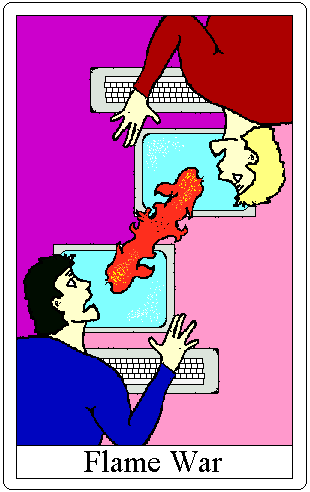
One of the heroes of the last 60 years has shown again his most critical side. If other times were GNOME times, now it's FSF turn again:
- Linux has never been an FSF project, and has never even been a "Free Software" project.
- The whole "Open Source" renaming was done largely exactly because people wanted to distance themselves from the FSF.
- So go fight the problem [DRM] at the source of the problem, not in my project that has got nothing to do it.
- I absolutely hate how the FSF has tried to use my code as a weapon, just because I decided that their license was good.
- [To Michiel de Boer] Write your own kernel and poll which one is more popular.
Some people say Linux is flaming, others just think he's the voice representing against the FSF what many of us think. Or may be they are just humans after all.